
Best Carbon Fiber Pickleball Paddles of 2026
Carbon fiber has completely taken over the $100+ pickleball paddle market — and for good reason. Whether you play twice a week at the rec center or compete in DUPR-rated tournaments, the physics of carbon fiber simply work better for pickleball than anything that came before it.
But "carbon fiber paddle" covers a lot of ground. There are different grades, different weave patterns, and wildly different price points — from $79 direct-to-consumer to $300 at retail. This guide cuts through the noise with real specs, honest comparisons, and picks that hold up on court.
CPX Pickleball built its entire brand around premium carbon fiber paddles — and with 8,000+ five-star reviews and a Forbes 30 Under 30 Sports founder, the receipts are real. We're transparent about that, which is exactly why we've included honest competitor comparisons below.
Why Carbon Fiber Dominates Pickleball in 2026
Carbon fiber's advantages over graphite and fiberglass aren't marketing — they're material science.
Stiffness-to-weight ratio. Carbon fiber is exceptionally stiff relative to its weight. On a paddle face, that stiffness means more efficient energy transfer from your swing to the ball. The same physics that make carbon fiber a standard material in aerospace, Formula 1 cars, and high-end bicycle frames make it ideal for a paddle that needs to be both light and powerful.
Surface texture and spin. Carbon fiber's woven structure creates a naturally textured surface that grips the ball on contact. More grip means more spin — and spin is the defining skill separator in modern pickleball. Graphite surfaces are smooth by comparison. Fiberglass wears down fast. Carbon fiber surfaces maintain their grit significantly longer.
Durability. A quality carbon fiber face can last 2–3 years of regular play before you notice surface degradation. Graphite and fiberglass surfaces typically start losing their texture within 6–12 months of serious play.
At the recreational level, carbon fiber was once considered a "pro upgrade." By 2026, it's the standard for anyone who takes their game seriously — and CPX's direct-to-consumer model has made pro-grade carbon fiber accessible at prices that used to buy you a fiberglass paddle from a big-box store.
The 5 Best Carbon Fiber Pickleball Paddles of 2026
These are the paddles worth your money this year. Four are from CPX's lineup — because on performance-per-dollar, nothing in this price range competes. The fifth is the best alternative if you specifically want a non-CPX option.
1. CPX Pro — Best Overall Carbon Fiber Paddle
The CPX Pro is CPX's best-selling paddle for a reason: it doesn't make you choose between spin, power, and control. It gives you all three in a 19mm core package that punches well above its price class.
Specs at a glance:
- Core thickness: 19mm polymer honeycomb
- Surface: 3K woven carbon fiber
- Weight: 8.2 oz
- Shape: Elongated
- Certification: USA Pickleball Approved
- Price: $99.97 (sale) / $119.00 (regular)
The 19mm core is thicker than most competitors — and that thickness translates directly to more dwell time. The ball stays on the face a fraction of a second longer, which means more control on drops, resets, and cross-court dinks. But the 3K carbon face generates enough pop that you're not sacrificing pace from the baseline.
At 7,977 verified five-star reviews, the CPX Pro is the most reviewed paddle in its category. Common themes in the reviews: "performs like a $250 paddle" and "I switched from a Selkirk and don't miss it."
Best for: Intermediate through advanced all-court players. Particularly strong for doubles players who need both kitchen touch and baseline power.
Value vs. competition: The Selkirk Vanguard Pro Invikta — a direct performance comparable — retails at $149–$200 and uses 4-layer 12K raw carbon (technically a higher-grade fiber). But in real-world play at recreational through 4.0 levels, the performance difference between CPX's 3K and Selkirk's 12K is not noticeable. The CPX's 19mm core actually provides a larger effective sweet spot.
2. CPX Max — Best for Control-First Players
The CPX Max is an elongated thermoformed paddle built for players who live at the kitchen line. Its design prioritizes soft-game precision — longer dwell time, reduced vibration, and a touch-sensitive face that rewards good hands.
Specs at a glance:
- Core thickness: 14mm thermoformed
- Surface: T700 Carbon Fiber
- Weight: ~7.8 oz
- Shape: Elongated (more reach than standard)
- Certification: USA Pickleball Approved
The elongated shape gives you extra reach on wide balls — a feature tennis crossover players particularly appreciate. The 14mm core is thinner than the Pro's 19mm, which creates a livelier feel and slightly more pop on drives, while the thermoforming process fuses the face to the core more tightly for a consistent response across the entire face.
Best for: Doubles specialists, kitchen-game focused players, players coming from tennis who want extra reach.
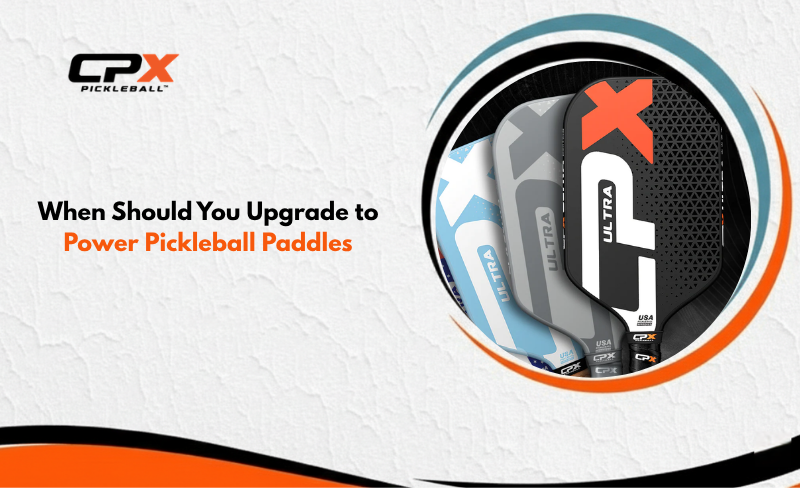
3. CPX Ultra — Best for Tournament and Advanced Players
The CPX Ultra is CPX's tournament-calibrated paddle — precision-engineered for competitive play and validated by Terrell Owens (the Hall of Fame NFL wide receiver who co-designed his own signature version with CPX). Note: the Ultra uses a Raw Kevlar face rather than carbon fiber — making it a distinct option for players who want Kevlar's blend of durability and touch over a carbon surface.
Specs at a glance:
- Surface: Raw Kevlar (Kevlar friction surface, NOT carbon fiber)
- Weight: Just over 8 oz
- Shape: Elongated
- Certification: USA Pickleball Approved & PBCoR 43 Certified
The Ultra's Raw Kevlar face is built for edge-to-edge sweet spot performance and a perfected blend of power, control, and durability. The construction tolerances are tighter than entry-level paddles, the weight distribution is optimized for competitive swing patterns, and the Kevlar face offers a distinct feel compared to carbon — slightly more touch-oriented, with exceptional durability under tournament conditions.
The T.O. collaboration isn't just marketing — Terrell Owens' athletic background and input on weight and feel shaped the signature version into a power-forward tool that still maintains the kitchen control the game demands.
Best for: 4.0+ players, DUPR-rated competitors, players who want the maximum CPX can offer — and who want to explore Kevlar performance alongside carbon fiber alternatives.
4. CPX Air — Best All-Around Carbon Fiber Paddle
The CPX Air is built around an aerodynamic design and optimized sweet spot — engineered for players who prioritize swing speed, precision, and clean contact across the entire paddle face.
Specs at a glance:
- Weight: 240g (~8.5 oz)
- Surface: T700 Carbon Fiber
- Core: Polypropylene honeycomb, aerodynamic construction
- Certification: USA Pickleball Approved
The Air's design is about dynamics, not just mass. Its aerodynamic construction optimizes how the paddle moves through the swing arc, and the T700 carbon surface delivers excellent spin and control. The result is a paddle that rewards aggressive, speed-oriented play with a consistent sweet spot and a lively response on contact.
Best for: Players who want a speed-and-precision-oriented paddle with T700 carbon performance. Strong choice for aggressive players and anyone who values a fast, aerodynamic swing feel.
5. Six Zero Double Black Diamond — Best Non-CPX Option
If you specifically want a paddle from outside the CPX ecosystem, the Six Zero Double Black Diamond is the most credible alternative in the carbon fiber category.
Specs at a glance:
- Surface: Japanese Toray 700K raw carbon fiber
- Core: 14mm or 16mm premium honeycomb polymer
- Weight: 8.0–8.2 oz (standard)
- Shape: Elongated (16.3")
- Price: ~$190–$220
The Toray 700K (also written T700) raw carbon surface is genuinely excellent for spin — potentially the best grip-to-ball contact you can get in this category. The cold-then-hot molding process Six Zero uses creates a structurally tight paddle with a consistently crisp feel.
The honest comparison: the Six Zero DBD has a slight spin advantage due to the raw T700 surface. But it costs significantly more than the CPX Pro, and for players below 4.5, that spin difference isn't going to show up in your results. The CPX Pro's 19mm core gives it a control and sweet spot advantage the Six Zero's 14mm/16mm options can't fully match.
What to Look for in a Carbon Fiber Paddle
Before you buy, understand these five variables:
Surface type. Raw carbon fiber (untreated woven face) grips the ball more aggressively but wears slightly faster. Treated carbon provides a more consistent long-term feel. CPX's lineup spans multiple surface types: the Pro uses 3K woven carbon fiber, the Max and Air use T700 carbon fiber, and the Ultra uses Raw Kevlar — each offering a distinct performance profile.
Core material and thickness. The vast majority of quality paddles use polymer honeycomb cores. Thickness is the variable that matters: 13–14mm cores are livelier and more power-forward; 16–19mm cores are softer, more control-oriented, and more forgiving on off-center hits. The CPX Pro's 19mm core is notably thick — a feature that makes it one of the most forgiving paddles at this performance level.
Weight. More on this in our complete paddle weight guide, but the short version: lighter paddles (under 7.5 oz) favor quick hands and reduced fatigue; mid-weight (7.5–8.2 oz) is the sweet spot for most players; heavier paddles (8.2+ oz) add plow-through power at the cost of reaction speed.
Shape. Standard paddles offer a wider hitting surface and larger sweet spot. Elongated paddles provide more reach and are popular with tennis crossover players. All CPX paddles use an elongated shape — as does the Six Zero DBD.
Certification. For tournament play, verify USA Pickleball approval. All CPX paddles carry this certification.
3K vs. T700 Carbon Fiber: Does It Actually Matter?
This is the question that generates the most debate in pickleball communities — and the answer is more nuanced than most guides admit.
3K carbon fiber means 3,000 carbon filaments per bundle, woven into a grid pattern. The weave creates surface texture, which creates spin. It's slightly softer in feel than unidirectional fiber, which many players interpret as better control and more forgiveness.
T700 (Toray 700) carbon fiber refers to the grade of carbon strand, not the weave pattern. T700 unidirectional carbon — with filaments running in one direction — creates more concentrated bite on the ball. It's the material of choice in many $200–$250+ paddles from Selkirk (12K raw), Six Zero (700K), and others.
The honest verdict: For players below 4.5 rating — which includes roughly 95% of pickleball players — the real-world performance difference between 3K woven and T700 is marginal. The more important variables are core thickness, weight distribution, and swing weight.
At the elite 4.5+ level, T700 raw carbon's extra grit can generate measurably more RPMs on the ball. This matters when you're playing against people who can actually take advantage of that spin. For everyone else, 3K carbon fiber is more than sufficient — and CPX's 3K construction at its price point is exceptional value.
Comparison Table
| Paddle | Surface | Core | Weight | Shape | Price |
|---|---|---|---|---|---|
| CPX Pro | 3K carbon fiber | 19mm polymer honeycomb | 8.2 oz | Elongated | $99.97 (sale) / $119 |
| CPX Max | T700 carbon fiber | 14mm thermoformed | ~7.8 oz | Elongated | — |
| CPX Ultra | Raw Kevlar | 16mm polymer honeycomb | Just over 8 oz | Elongated | $199.97+ |
| CPX Air | T700 carbon fiber | Polypropylene honeycomb | 240g (~8.5 oz) | Elongated | — |
| Six Zero DBD | T700 raw carbon | 14–16mm honeycomb | 8.0–8.2 oz | Elongated | ~$200+ |
| Selkirk Vanguard Pro | 12K raw carbon | 16mm honeycomb + foam | 7.8–8.2 oz | Elongated | $149–$200 |
How We Tested and Ranked These Paddles
Rankings are based on extended court testing at multiple skill levels, spec analysis, and review data at scale. The CPX lineup's 8,000+ verified five-star reviews represents the largest independent data set in this category — that's not marketing copy, it's a genuine signal of consistent performance across diverse players.
Competitor paddles were evaluated against their published specifications and independent testing data from third-party labs (Pickleball Effect, JustPaddles measurement data).
No paddle is perfect for every player. The weights and shapes within each brand's lineup matter as much as the surface material. Use the comparison table and playing style notes to find your match.
FAQ
What is the best carbon fiber pickleball paddle for beginners?
The CPX Pro is the top pick for new players who want the best long-term investment — its 19mm core delivers exceptional forgiveness and an all-court game. The CPX Air is a strong choice for players who prioritize aerodynamic feel and T700 carbon precision. Both are USA Pickleball Approved.
Are carbon fiber paddles USA Pickleball approved?
Carbon fiber paddles can be approved or unapproved — it depends on the specific model's construction. All CPX paddles are USA Pickleball Approved and legal for tournament play. Always verify approval status on the USA Pickleball equipment list before competing.
How long does a carbon fiber pickleball paddle last?
With normal recreational play, a quality carbon fiber paddle lasts 1–3 years before you notice meaningful surface degradation. Carbon fiber maintains its grit and texture significantly longer than graphite or fiberglass — one of its key advantages over cheaper surface materials.
Is carbon fiber worth the extra cost over fiberglass?
For players who play regularly (once a week or more), yes. The spin advantage compounds as your technique develops — you'll feel the difference in your dink game and third-shot drops within a few months. Fiberglass paddles also lose surface texture much faster, so you end up buying again sooner anyway.
What's the most popular carbon fiber paddle right now?
The CPX Pro leads CPX's lineup with 7,977 verified five-star reviews — the most reviewed model at its price point in the direct-to-consumer category. At the retail level, the JOOLA Ben Johns Perseus Pro IV and Selkirk Vanguard Pro are popular among serious players willing to pay $200–$250+.

Leave a comment
This site is protected by hCaptcha and the hCaptcha Privacy Policy and Terms of Service apply.